
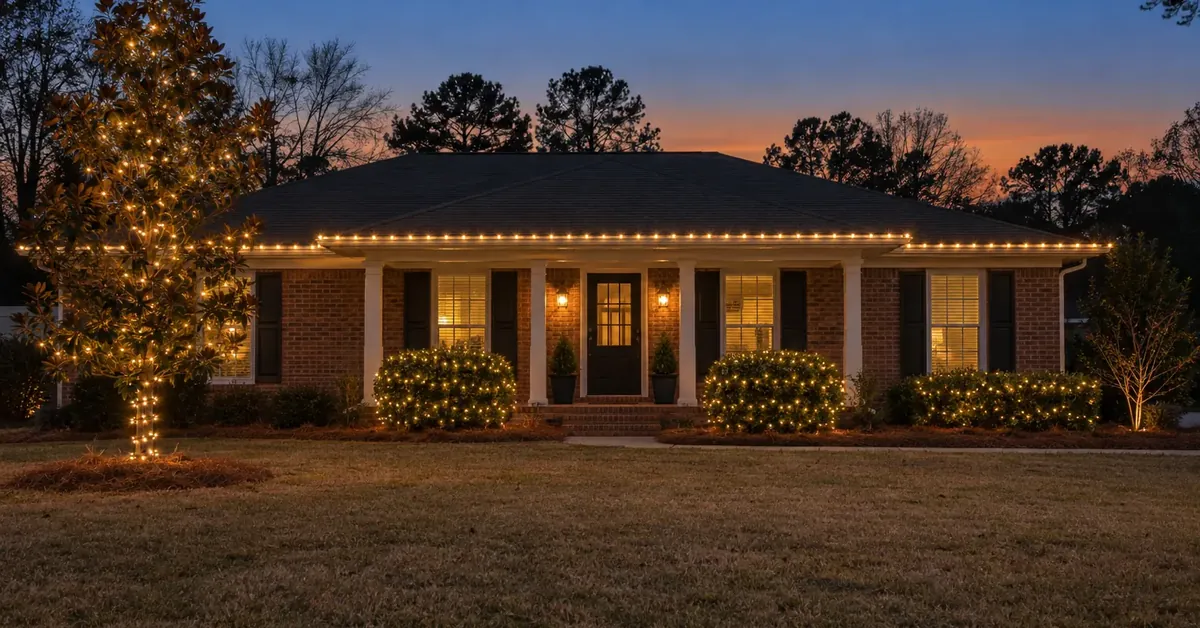
Professional Christmas lights look polished because of planning, not extra bulbs. Installers map the layout first, use one bulb type and color temperature, space clips evenly, keep lines straight, hide cords, and test everything before hanging. A homeowner can copy most of that with a measuring tape, a plan, and patience.
What makes professional Christmas lights look different from DIY lights?
It is rarely the lights themselves. The difference is consistency. A well-done professional install aims for strands that match in color, evenly spaced bulbs, lines that follow the architecture of the house, and as few visible extension cords, sagging runs, or dark gaps as possible.
A messy display usually has the same few problems:
- Mixed bulb colors, such as warm white next to cool white
- Lines that dip between clips or wander off the roof edge
- Too many different ideas at once (icicles, net lights, pathway lights, and wraps with no connecting theme)
- Visible cords, plugs, and splices
- Dark sections where a strand died or a connection came loose
Addressing those five things can make a substantial difference in how clean a display looks.
How do you plan a light layout before you hang anything?
Planning helps every project, whether a crew is doing it or you are tackling it over a weekend. Before any light goes up, walk the front of the house at dusk from the street and from the driveway. Decide which features you want to highlight: the roofline, columns, the front door, a few trees, and the foundation shrubs. Then pick a limit and stick to it.
Here is a simple planning routine you can copy:
- Sketch the house. Draw a rough front elevation and mark every run: roof edges, gables, window trim, trees, and beds.
- Measure each run. Use a tape or a measuring wheel for ground features. Add extra for corners and returns.
- Locate your power. Mark each outdoor outlet and decide which runs plug into which one.
- Choose a color story. A single warm white, or one warm white base with a single accent color, is a simple way to look intentional. A multicolor display can work too, but it takes more care to look coordinated.
- Count and buy once. Order a bit more than you need, from the same product line and batch if possible, so colors match.
Our Holiday Lighting service includes custom design and layout for this reason. Deciding what goes where, and where the power comes from, happens before the first clip is attached.
Should you start lights at the top or the bottom of the tree?
It depends on the tree and the wrapping method, but the goal is always the same: even coverage with the plug end near your power source.
- Wrapping the trunk and main limbs of a live tree: start at the base and work up, then out along the branches. This keeps the spacing even and the plug end at the bottom.
- Cone-shaped trees and evergreens: many installers anchor at the top and run strands straight down in vertical lines, evenly spaced around the tree. Vertical runs look cleaner from the street than a loose spiral, and they are easier to fix if one strand goes out.
- Small potted or artificial trees: either direction works. Pick one, keep the spacing consistent, and finish with the plug at the bottom.
Whichever method you use, light the tree from the inside out. Put some bulbs on the inner branches too, not just the tips. A tree with depth looks fuller than one with a flat shell of lights.
How do you keep roofline and shrub lighting even and straight?
Roofline
Straight lines come from clips, not tape or staples. Use clips made for your gutter, shingle edge, or fascia, and set them at a consistent spacing. Many installers place a clip roughly every 12 to 18 inches, closer if the strand has heavy bulbs or sags. Check the manufacturer's guidance for your bulb type.
Run a line along the roof edge and keep the bulbs facing the same direction. At corners and peaks, plan where one strand ends and the next begins, so the joint is hidden and not sitting mid-span. Work from a stable ladder with someone spotting you, and skip steep or high roof sections entirely if you are not comfortable up there.
Shrubs and beds
Shrub lighting goes wrong when the lights are draped in loose loops. For a clean look, either outline the shape of the shrub with a single run, or use net lights on dense, uniform shrubs. For larger, looser plants, wrap each branch from the inside out so you get glow from within.
Keep the density the same from one shrub to the next. A common amateur mistake is one bush packed with lights and the next one nearly bare.
Match your bulbs
Do not mix warm white and cool white on the same house. Different brands and even different batches can vary slightly, so buy matching strands together. Test every strand on the ground before it goes up, and replace any that flicker or have dead sections.
How do you power and protect lights in damp weather?
In the Chattahoochee Valley, humid air and heavy rain are part of the climate, and moisture can cause trouble for holiday lights and their connections. A few habits help a display keep running all season:
- Use outdoor-rated products only. That goes for lights, extension cords, and timers.
- Plug into GFCI outlets. If your outdoor outlet is not GFCI protected, have an electrician check it.
- Respect load limits. Check the maximum number of strands that can be connected end to end and the total wattage on each circuit. LEDs draw far less power than older incandescent strings, which gives you more room.
- Keep connections off the ground. Plugs sitting in puddles or mulch are a common reason a section goes dark after a storm. Use weatherproof covers and elevate connections.
- Make drip loops. Let each cord hang slightly lower than the plug so water drips off before reaching the connection.
- Use a timer. It gives you a consistent on and off schedule, and it avoids lights running all night.
Check the display after the first heavy rain. It is a good time to catch a loose connection before the holiday week.
When is it worth hiring an installer instead of doing it yourself?
Hanging a wreath and a few strands on the porch is a good DIY project. The case for a professional grows with height, complexity, and your time.
Consider calling a pro if:
- Your roofline is steep, tall, or has multiple gables
- You want large trees wrapped or lit canopy to ground
- You do not want to deal with ladders, power load math, or storage
- You want one consistent design across the roofline, trees, and beds
- You would rather not take everything down and pack it away once the season is over
At Greenz Outdoor Services, one crew plans your project and the same crew builds it. Our holiday lighting service covers installation, custom design and layout, and lighting removal, so the plan and the finished display stay connected.
If you want to talk through your house, use our contact page to Request An Estimate. If you decide to do it yourself, the planning steps above will still serve you well.
Frequently Asked Questions
How many lights does a tree need to look full?
It depends on the size of the tree and how dense you want it, so treat any number as a starting point. Packages often suggest a number of mini lights per foot of tree height, and a denser count gives a fuller look. Wrapping inner branches as well as the tips adds depth with fewer bulbs.
Should all the bulbs be the same color temperature?
Yes, on the same house and in the same view. Mixing warm white and cool white looks mismatched, even when the difference seems small in the box. Buy matching strands together and test them side by side before you hang them.
How far apart should roofline clips be spaced?
A common range is one clip every 12 to 18 inches, with closer spacing where the line sags or the bulbs are heavy. Check the manufacturer's guidance for your product. Consistent spacing matters more than the exact number, because it keeps the line straight.
Are LED or incandescent lights better for a professional look?
Both can look good, but LEDs are the easier choice for most homes. They use less power, run cooler, and let you connect longer runs on one circuit. The key is matching the color temperature and bulb style across the whole display.
When should Christmas lights come down in Alabama and Georgia?
There is no single date, and some HOAs or neighborhoods set their own, so check with yours. Many people take lights down in early January on a dry day. Waiting until spring can mean brittle cords, rain damage, and more work in warm weather.